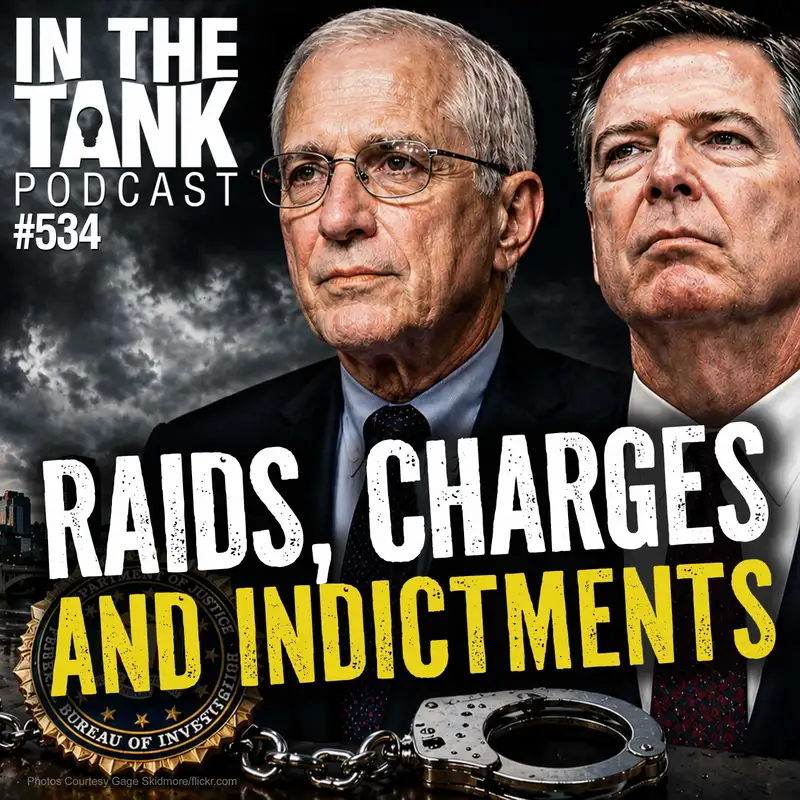
Raids, Charges, and Indictments — In the Tank Podcast #534
Download MP3Alright. We are now live. Welcome to the show, everyone. Lots happening this week, so it was hard to choose from. But we what we are going to cover here are the federal raids on allegedly fraudulent businesses in Minneapolis and governor Tim Waltz's very, very sad attempt to take credit.
Linnea Lueken:And the supreme court says no to race based congressional districts, which should have been self evident, but apparently it needed to be fought out in the courts. And two major figures from the Biden administration are being hit with indictments, former FBI director James Comey for threatening the president with social media post and a former senior aide to famous alleged puppy killer Anthony Fauci. And for Unhinged, Ann Arbor is getting rid of neighborhood crime watch signs that make minorities feel or in order to make minorities feel more welcome. That is not a joke. They're that's their reasoning.
Linnea Lueken:We are going to talk about all of this on episode 534 of the In The Tank podcast.
Karoline Leavitt:When you read the manifesto of this shooter, ask yourselves, how different is the rhetoric from this almost assassin than what you read on social media and hear in various forums every single day? The answer, if you're being honest with yourself, is that there is no difference at all. Much of the manifesto of the would be assassin is indistinguishable from the words that we hear daily from so many.
Linnea Lueken:Alright. Welcome to the In the Tank Podcast. I am Linnea Lueken, your host. And as always, we also have Jim Lakely, vice president and director of communications at the Heartland Institute. We have Sam Karnick, senior fellow at the Heartland Institute.
Linnea Lueken:And, of course, Chris Talgo, editorial director and socialism research fellow. Welcome back, Chris. And we also have producer Andy Singer in the background, keeping the show moving along. Alright. So once again, nothing at all is going on in the news.
Linnea Lueken:Had a really hard time finding topics for the show. No. One of the things I decided to save for the Comey indictment topic today is the recent major assassination temp attempt on president Trump and his cabinet. It's kind of insane, though. We can talk about this a little bit just at the intro here.
Linnea Lueken:How this is just kind of like normal news at this point. It's still crazy, but I feel like the news cycle moved on really fast this time.
Jim Lakely:Yeah. That's yeah. I added that to our to our intro. I added that little stinger at the end because I thought, hey. You know, I did that on Monday, think.
Jim Lakely:Hey. We'll probably be talking about this. I'll drop that in there. We will talk about it a little bit. But, yeah, it I'm trying to imagine what the media coverage would be like if this happened during Obama's presidency.
Jim Lakely:If somebody had came within, I don't know, 30 yards with fully armed with shooting up the the White House Correspondents Association dinner, I think we might it it still might be the lead story on most of cable newsnets today. I'm I'm pretty I'm pretty sure. We'd probably have a special all these new specials on the networks talking about it all the time. It left the news cycle before the weekend was over, and it happened on Saturday. It's it's crazy.
Jim Lakely:I mean, we can get into it more in the you know, when we get further along the show today, but, you know, it's it's it's the the idea that it's become routine for people to attempt to kill the president of The United States and the media just basically brushes it off. It's shocking and it's really disturbing, to be frank.
Linnea Lueken:Yeah. Well, and and part of my sorry, Sam. Just a second. Part of my argument for not having it be its own category this time is just kind of like, what, I mean, what do we say about this that we haven't said every other time that the that there's, like, a crazier what do we what do we say about this that we don't say on unhinged almost every week, right, that the rhetoric is getting so absurd from the left that it's no surprise whatsoever that, there's all these attacks. And and, Sam, sorry for cutting you off there.
S.T. Karnick:Oh, no problem. I think the the one thing we can say is that this kind of rhetoric is clearly leading to assassination attempts, and assassination attempts make a person feel unwelcome. And so we should turn that around.
Chris Talgo:You know, I I I I kinda also equate this with what happened with, the murder of, that UnitedHealthcare CEO and some other, prominent figures, I think that we live in a day and age in which, murder is becoming more or less justified by a big part of the public. And although this person obviously didn't commit murder, the fact that the, I think a big part of the public is saying, well, you know, actually, he had he had the right motives and, you know, like, he he he, you know, he he had the right intention is really scary.
S.T. Karnick:Really, we're Everybody knows you never go full retard.
Linnea Lueken:I don't know about that drop on this one, Andy. But, yeah, it's the justification is, you know, they they say, how many times, you know, can the media call Trump Hitler before someone's like, well, you know, you know, I would have killed Hitler and then go after him. And so we'll get into it a bit more in the Comey section, but I just wanted to open it up with that. This is serious, you guys, and it's a I I don't think this is the last time we're going to see this, which is very unfortunate. But before we get started here, if we want to support this show, you can go to heartland.org/inthetank and donate there.
Linnea Lueken:Please also click the thumbs up on the video. Once again, I see all you guys in the comments. All of you have no excuse. Go hit the like button, if if you so please anyway. And remember that sharing it can also help break through some of YouTube suppression.
Linnea Lueken:And even just leaving a comment helps us too. If you're an audio listener, you can help us out by leaving a nice review. Alright. So I'm gonna get us into Unhinged. This is a bit of a a different kind of topic, but it is related to our intro because the the left is just crazy.
Linnea Lueken:I there's really no other way to they don't hear the things they say or if they do, I don't know how they they justify this stuff. So I'm filing this situation under the category of the bigotry of low expectations. I know we have a good number of a of minority or non white viewers here, so I would love to see your input on this insaneness in the comments here. So we have from the post millennial, Ann Arbor removes the last neighborhood crime watch sign to be inclusive to people of color. Ann Arbor, Michigan has removed all of their neighborhood crime watch signs.
Linnea Lueken:The last one was torn last week in a ceremony attended by city council members Cynthia Harrison and Jen Eyre along with mayor Christopher Taylor. They took down the signs to be inclusive and to make people of color feel welcome. We want to be inclusive, Harrison said, and there are people that don't feel welcome, and that's not who we are. That does not align with our values. And so this is a great day.
Linnea Lueken:There were 600 blue and white neighborhood crime watch signs in the city as of December, but now they are all gone. The removal of the signs comes after the neighborhood crime watch program has substantially ended. The city hasn't had an active neighborhood watch program for years, reports WAMU. Critics say it didn't reduce crime nearly as much as it targeted people of color. Speaking to Michigan Daily in January after the city council voted to remove the signs, a college freshman said seeing signage in the surrounding areas of their school could feel like there's a level of surveillance and suspicion.
Linnea Lueken:That feeling is particularly more acute for students of color, especially if you come from somewhere where you have experienced or are familiar with racialized suspicion, the student said. Some students living in these neighborhoods might feel safer seeing any signage. So I can understand that it would potentially improve their sense of safety, but I don't see how signs to promote vigilance would foster any sense of belonging. Alright. So that's nice.
Linnea Lueken:I understand taking down the signs of the community watch hotline was, you know, no longer active, which it apparently wasn't. And there just wasn't an organized system for it anymore. But, I mean, Chris, why on earth did they need to frame it this way with their ceremony in, like, a racial context? Do they really think that taking down these signs is going to stop some, like, hyper parent hyper paranoid old lady from calling the cops on, like, kids riding bikes or a black guy in their neighborhood they don't recognize. Of course, it's not going to.
Chris Talgo:This is virtue signaling. And Ann Arbor, Michigan, I am somewhat experienced with it because my aunt lived there lives there. Excuse me. And my sister went to University of Michigan, so I visited a bunch of times. And we've gone back in the years since for, you know, other things.
Chris Talgo:Ann Arbor, Michigan is about as liberal a town as I think I've ever been in. I mean, it was everywhere you go, it is it is, you know, just radical leftists and and and signs and all sorts of stuff. So this does not surprise me. This is probably, you know, par for the chorus in a place like Ann Arbor. It's not gonna actually do anything.
Chris Talgo:It's not going to, you know, help, with crime in in those areas, but it's gonna make those those council members, you know, feel better about themselves. So that that's that's what this is all about. It's sad.
Linnea Lueken:Yeah. One of our viewers points out that, Rush Limbaugh would have said this is symbolism over substance. But but what's the symbolism here that they're suggesting?
S.T. Karnick:You know, it's it's interesting because when you stop doing a program of some sort, you take down the signs. Yes. You take down the road signs for it. But you don't have a ceremony. You just take them down because they're they're not relevant anymore.
S.T. Karnick:But you have a ceremony. You know, it's almost as if these politicians were trying to signal that they have some particular virtue. And that virtue is the idea that, well, we are welcoming to everyone of every kind no matter what they look like and blah blah blah blah, which is fine. But the point is that what you are saying, though, when you characterize it as a racial matter, then you're saying that people associate crime with a particular look. Now you're the ones who are saying that.
S.T. Karnick:I I didn't hear anyone else saying it. Nobody put it nobody, on the neighborhood watch was saying, hey. Look out for people who look a particular way, except insofar as, yes, a particular way if they're driving their car faster than neighborhood or they're obviously going around to the backs of of houses that are, unoccupied at the moment, those are, signs that there may be crime about to happen, and that's what these crime watches are for. But to characterize it as being a social issue, that watching out for crime makes people feel uncomfortable because they are themselves then being being seen as criminals or potential criminals, well, that's just stupid and wrong, but that's the way things go nowadays.
Jim Lakely:Yeah. I'm with Sam. I mean, the reading the story, a couple things struck, you know, me. One is, like, it really warranted a ceremony, a public ceremony to remove neighborhood watch signs. I mean, jeez, aren't there more important things that I'd actually be in favor of ceremonies for filling potholes.
Jim Lakely:That's probably something that's better for the city to be doing, especially in the spring. But, you know, I remember being a kid. I lived in Dayton, Ohio for a little bit, and I remember walking around my neighborhood, and I would see those neighborhood watch signs, you know, on the on the street. And, you know, as a kid, it made me feel safer. And what it meant to me was that my neighbors were looking out for each other.
Jim Lakely:What's wrong with that? It made me feel safer as a kid. Don't I mean, you know, maybe didn't have anything. It's, you know, it's mostly just a it's a per show thing anyway. But to me, it always signaled that this is a neighborhood in which neighbors are looking out for each other in the neighborhood I'm in right now.
Jim Lakely:My neighbors and I, we look out for each other. We look out if we see something suspicious. We well, now you can text people and say, hey, there's something there's a guy I don't know who should be in your yard. He's in your yard. And so, you know, this is just normal neighbor y things.
Jim Lakely:But, you know, who doesn't want to live in a safe neighborhood? Does your race or ethnicity affect your desire to be safe? I don't get it. Know, you've stated this before, Linnea, but like people on the left, they see themselves as so progressive. Sam said this too, so progressive and so virtuous.
Jim Lakely:But they're they're obsessed with race that like they don't even hear themselves. I mean, do you hear what's coming out of your mouth? Do you realize the implications of this? It's so patronizing. And reading through that story, the first reference to it would make minorities not feel comfortable in our neighborhood.
Jim Lakely:Thought, oh, that's just a one off. Literally, every other paragraph was making the same point over and over again Yeah. Because the people in Ann Arbor were making the point over and over again. It's like, do you even hear yourselves? This this obsession with race, we're gonna get into it, I guess, with the supreme court decision in a little bit.
Jim Lakely:It's it's not healthy, and it can turn into a situation where you're publicly stepping on rakes all the time, and you don't even realize what's going on.
Linnea Lueken:I remember when I was a kid, the neighborhood watch sign in our area was like a a like a silhouette of a guy in, like, a trench coat with the collar pulled up in the top and, like, the fedora hat. Right. Like a like a mobster or something creeping around with a nice big, like, x over him. And, man, that was cute. But I wonder I wonder if the I wonder if there's a bigger, you know, underlying societal change here that we're going we're becoming, I guess, more more fractured in our neighborhood security because now what yeah.
Linnea Lueken:There he is. That's the guy. When I was a kid, I thought it looked like a bird or something opening its beak. But the I I wonder if we're becoming, like, more isolated in the way that we defend ourselves in that. Like, we all just have blink cameras now.
Linnea Lueken:We all just have our own little security systems and stuff. And so maybe that's why the neighborhood watch isn't so much a thing because there really isn't like a community in a lot of places anymore. And I think that's kind of a bad sign probably for the long run. I think Doug Troyer in our comments made that point too. He said, it's society's foundation being torn down, hence the sign is that symbol being torn down.
Linnea Lueken:Yeah.
S.T. Karnick:The key is that they don't want people to do things for themselves. They want people to depend on the government. And so the the ring and well, whatever you wanna call them, the the kind of doorbell video cameras and so forth, those are all the public responding to the fact that these these other options of protecting themselves have been taken away from them. So you've had incidents in The United States. It's much bigger in Britain that people who defend themselves from home invaders and the like, are instead prosecuted by the government.
S.T. Karnick:The home invaders get away with it. And and that has been happening in in The United States to a a very serious degree in itself. And it's all part of the state, the government, trying to ensure that no one has any authority over anything on their own. And so what happens here is that you get this situation where you you want to protect your home. You want to protect your neighbors.
S.T. Karnick:You want to help your neighbors protect their homes. And then you're told that you can't do it, and the government makes sure that you know by prosecuting people who do do it. And then all that's taken away from you. So all you can do is put up a camera, and soon enough, those cameras will be will be controlled by the government, the state government in particular. And that's the way it works.
S.T. Karnick:They take power away from the individual so that you won't have control of your life. You won't have authority over yourself. They have it all. And that's the this system is just always reacting to anything that happens with more concentration of power to itself.
Linnea Lueken:Yep. And I'm gonna move us along here because speaking of, the system, trying to put more power on itself. So we have had some big raids this week on different businesses across Minneapolis. So The Daily Caller has a good story covering this one. Feds raid the infamous quality leering center.
Linnea Lueken:Other businesses tied to alleged smelly fraud. Federal agents raided multiple locations across Minneapolis, Minnesota Tuesday as part of an ongoing fraud investigation, including the infamous daycare accused of corruption, the Quality Learning Center, formerly known as the Quality Luring Luring Center, officials say. Mulligan said that the raids come on the heels of court approval for 22 search warrants pertaining to social service fraud allegations and not illegal immigration. Both the investigations and heightened immigration enforcement in that Minnesota area followed federal prosecutors' allegations in December that approximately $9,000,000,000 was looted from Medicaid in the state. The issue of Minnesota social services fraud caught national attention in late December when independent journalist Nick Schieber released a viral video accusing and confronting businesses in day care centers often Somali linked that he was claimed were tied to the theft of government aid.
Linnea Lueken:The Daily Caller has previously reported that the Somali government and local terror group Al Shabaab Al Shabaab, that's it, may play a large role in enabling the fraud by allegedly trafficking people into The United States with millions of US dollars leaving America to allegedly be exchanged into the hands of Al Shabaab before being laundered and brought to Somalia. Quality Luring Center did not respond to the daily caller's request for comment. I left that in there because I thought that was really funny. Anyway, so most hilarious about these raids was the response though from governor Tim Waltz who I want to remind everyone was almost vice president of The United States. That's a, like, a wow.
Linnea Lueken:Your life flashes before your eyes a little bit thinking about it. So Walt responded those weeks ago to Nick Shirley's initial reporting on the fraud that he discovered by doing actual journalism and going door to door. And and so at that time, Waltz called him a white supremacist and insisted that there's no fraud at all. In fact, state employees said that Waltz threatened and retaliated against Department of Human Services whistleblowers who were worried about fraud. Remember all that grandstanding he did about not allowing federal agents to do immigration raids and fraud raids?
Linnea Lueken:Anyway, now he's saying this. If you commit fraud in Minnesota, you're going to get caught, and that's exactly what we saw today. We catch criminals when state and federal agencies share information, joint investigations work, and securing justice depends on it. Today's raids by state and federal law enforcement happen because our state agencies caught irregular behavior and reported it. That's how the system is supposed to work, and our agencies will keep at it as long as there are fraudsters around to put behind bars.
Linnea Lueken:Now let's work on a joint investigation into the killings of Alex Preti and Renee Good instead of cherry picking when we seek justice and when we turn a blind eye. Right, governor. I think there ought to be a joint investigation probably into how much governor Walts knew about all of this fraud. But as a temporary consolation, we did get to see a colossal ratio on his asinine post here. It was 23,000 comments to only 5,200 likes.
Linnea Lueken:Pretty incredible stuff. Alright, Sam. Most people discuss fraud from the perspective of the cheating and the breaking the law and the stealing money from taxpayers. All of those things are terrible. And our right first reaction to hearing about widespread fraud is to worry about that stuff.
Linnea Lueken:But there is another reason that it's important that our, you know, federal government or state government, whoever, someone's gotta crack down on this stuff, especially the really obvious fraudulent businesses where it's literally just like a a home or something that's being marked as some kind of a business and it has, like, 15 trucking businesses working out of it. That's suspicious. You gotta look into that because that kind of thing does have an impact on people's trust in not just the government, but the local economy too.
S.T. Karnick:The the states are responsible for distributing this money that comes from the federal government and following the statutes that establish these programs and how they're supposed to be managed. States don't do that, and many Minnesota is a perfect example of that. And so is California. Guess what? You can look at pretty much any blue state and find that there's an incredible amount, an absolutely incredible amount of fraud going on.
S.T. Karnick:Remember that, if you read my newsletter weekly, one the title of one of the, issues was the fraud is bigger than you ever imagined, and it is. It's lots bigger than you ever imagined. We're only starting now to to realize how much fraud was going on. Now the the states have not been enforcing it, but even red states have have problems with this. And a big reason is that the way these these these programs are structured in themselves creates opportunities for fraud and, in fact, encourages it.
S.T. Karnick:The the structure is that the federal government decides what these programs must do, and then it sends the money to the states and says, okay. Go ahead and and go ahead and and build these programs and maintain them. But what the states do then is let's say you're in a red state, and you're a really solid governor and, you really care, and you wanna stop fraud. What happens is you say, well, we need a system where we can match, say, Medicaid, applications to Medicaid recipients. Meaning, if they're already receiving Medicaid in in your state or in some other state, guess what?
S.T. Karnick:They can't receive Medicaid under under this, under another name or the same a different address or or whatever. So you put all that together, and then you say, well, we'll, run the computers. It's it's easy to do, but it's illegal. It's illegal according to the federal statutes. You can't share that information, or it's illegal according to the state statutes.
S.T. Karnick:You can't share that information. So what we really need to do is tear down a whole lot of things that are are put into these programs and put into the systems that simply create not just the the possibility of fraud. They make it inevitable and enormous. So that the the the system I I don't say that the system was devised to encourage fraud. But I do say the way the system is built, it does encourage fraud, and it encourages an enormous amount of fraud.
S.T. Karnick:Just not not just a little bit on the edges as as you've seen from Minnesota and California, and and it's going to crop up in other places as well. We're going to get much more documentation of this, I believe, as the federal government starts investigating these things. Because this is fraud on the state level, but it's also, and more importantly, fraud on the federal level. And the federal government is the entity that is collecting this money through taxes. And so they're the entity that is morally responsible and ethically responsible to make sure that the spending is honest and and fair.
S.T. Karnick:And who is harmed most by this? Well, it's taxpayers present and future because you're borrowing money to to to spend on all this, And it's also the recipients themselves because their the system, it cannot last. It can't it cannot continue to to take out this kind of money from the American people and have a a system that doesn't go into a debt spiral, which is what we're looking at. So the recipients themselves are being are being harmed and certainly being endangered very badly insofar as these programs actually do any good. So if you think these programs do any good, then you should absolutely 100% be against fraud and not just after the federal government reveals it and and and finds it out in your state, but long before that, the moment you take office, you should you should be on top of this.
S.T. Karnick:So that is the big problem is that the law itself not only not only allows but encourages this, and the the state governments have simply not done their true diligence on this and made sure that the money is going only to those who truly have been established by the laws needing it. As I say, that's different from them actually needing it. I I we don't know, you know, what what as as you see that you have people driving Mercedes and BMWs who are getting these benefits. That seems a bit odd to me, and I suspect that they probably don't need them. So but regardless, if that's what the law says, if that's what the people have said, then we're stuck with it until the people come to their darn senses.
S.T. Karnick:But but in the meantime, if it's illegal, you shouldn't do it, and you need to enforce the law. This this country has become so lax in enforcing the law. It's as if they're taking down the signs that say, don't commit crimes in this neighborhood.
Linnea Lueken:When I, yeah. Exactly. So I have kind of a follow-up question to that, but I did wanna point out that one of the things that pops into my head as you're discussing this and as you're talking about just, like, the sheer volume of the fraud and how easy it is, to commit it, I think about that chart that was going around, I think, last week talking about where all the money in schools is going, and it's going to a huge ballooning of an administrator class at these, you know, schools and stuff. And I'm sure the same is true at the local government level within these programs. So you would think that it would be easier for them to catch fraud except that it seems to be that, like, with many things with government, things just get worse as they patch it over time.
Linnea Lueken:Sometimes it seems to me, and I'm I'm wondering if you agree with this, Sam, that just like a total ground up overhaul is what they need to do to these programs when they discover that there's a issue in it or something that's being taken advantage of. But instead, it seems that what they've done is they just, like, patch a little here, patch a little there, but it actually ends up making things more complicated and worse over time.
S.T. Karnick:Absolutely right. And and you know where that happens? That happens in declining institutions and declining societies. You're you're heading for a crash when you do that, and you're, you're doing the patching because you don't wanna hold anyone in the bureaucracy responsible for it, and you don't wanna hold the government responsible for it. What you wanna do is is distract attention from these these crimes and make sure that nobody even knows that that they're happening.
S.T. Karnick:Well, think about this. If if people were going around murdering other people and the police were covering it up, you would consider that to be a bad thing. Well, this is not murder, but it's hundreds of millions of dollars per year. Think about that. Hundreds of millions of dollars.
S.T. Karnick:We have about, what, a 7,000,000,000,000 federal budget. 7 several trillion $7,000,000,000,000 federal budget annually. About one more than 1,000,000,000,000 of that is debt payments. And so any amount of fraud that you you have and and remember that the federal government the federal government is financed by borrowing. They're they're adding to the federal debt every year enormous amounts.
S.T. Karnick:So you take all that in in hand, and you have no excuse no excuse whatsoever for allowing any fraud to occur. None. Zero. As if you had any excuse even if you weren't in a dire, economic situation, a dire fiscal, catastrophe on the way. So this is obviously absurd.
S.T. Karnick:But, Linnea, what you pointed out was really the the right track to go down, which is that this isn't just a bad thing. Oh, naughty naughty, you know, do the kindergarten thing to you. No. It's not like that. This is the potential destruction of our entire government system on the federal level.
S.T. Karnick:Now some of us might think that that would be a pretty good thing if we start all over again, but there will be a heck of a lot of of distraught people, a heck of a lot of people suffering through that transition to a better society. We could do it consciously by ending this fraud, or we can do it we can be forced into it by the destruction of the system itself. My guess, as I always say, is we're going to get the latter.
Linnea Lueken:Well, that's very cheery. I wanted to show I was wrong. This it wasn't I'm sure that the chart looks very similar, for teachers and administrators at schools. But the one I was thinking about was this one from hospitals where since this is crazy. Since the seventies, look at the rate of an increase in number of physicians compared to administrative staff at hospitals.
Linnea Lueken:This, of course, is due to health insurance, which the government has caused to be a problem.
S.T. Karnick:Third party payment. Third party payment is the reason.
Linnea Lueken:Yep. So and I'm sure it's the same thing in these in these benefits. Yeah. These these benefit schemes at the at the state government level. I was trying to think of how I'm gonna say this.
Linnea Lueken:So does anybody else have a comment on this one? I don't wanna
Jim Lakely:Yeah. I mean, mean, I'm sure Chris does too, but, you know, you you had mentioned you started off the story there reading just $9,000,000,000, and that was just in Medicaid fraud in Minnesota. You know, you gotta remember, suitcases of cash were found flowing out of the airport in Minneapolis on their way we caught some of it apparently, but certainly most of it made its way back to Somalia. And there's evidence of widespread fraud in other federal and state programs. I mean, stuff like setting up a transportation company to shuttle the elderly to doctor's appointments that don't actually do that, but they build a taxpayer's for it anyway.
Jim Lakely:That's our money, by the way. The childcare fraud with the quality leering center being the most prominent. There's apparently an epidemic of autism among the Somali community in in Minnesota because by it's an absurd number of families from the Somali community in Minnesota that are claiming their kids are autistic and collecting money for that as well. Know, and all of this fraud, you know, investigators are alleging that state workers are in on it too. In fact, one of the charges is that they were altering documents to cover their tracks, that they knew it and and were trying to to cover their their their tracks.
Jim Lakely:Look. I have a very strong suspicion that this fraud was allowed to go on by the Democrats who have controlled Minnesota and Minneapolis with an iron grip for many, many years the reasons that it was helping them politically and financially. They were, at best, just turning a blind eye to this fraud. Whistleblowers have actually even said this, the few that have come out. But at worst, they're lining their pockets, they're guilty of some very serious crimes.
Jim Lakely:This likely goes a lot deeper, though I'm really losing confidence that we're ever going to get to the bottom of this, but it is simply not plausible that tens of billions of dollars in fraud, fraud that was so absurdly obvious, so obvious that a kid with an iPhone, Nick Shirley, is able to expose it just by walking around and knocking on doors. It is not plausible that this fraud was going to was going on, and literally nobody noticed it until just now. When we talked on this show about voter fraud a couple episodes ago, I said that the penalty for for being being convicted guilty of voter fraud needs to be severe, very severe. Like, twenty years in a federal prison severe. People committing fraud, especially on this scale, need to receive that same punishment or even worse.
Jim Lakely:And and, you know, deportation. If you're not here if you're here on a green card, if you're not a a naturalized citizen, and you're committing fraud against the taxpayers of The United States, you're abusing the wealth you know, you're basically taking a poop on the welcome mat that we put out here in United States to welcome you to this country, then you should you should go. You shouldn't be here. So is he the prison? Maybe prison first and then out.
Jim Lakely:Representative Anna Paulina Luna introduced a bill, I believe, in the last week or so, saying that that the federal government can revoke the citizenship or naturalized citizenship of any immigrant or anybody who is defrauding America. That seems very, very harsh. We could maybe talk about that. I'd like to have I've been interesting being a whole national discussion about that. But the idea that people that we've welcomed into this country who have applied for political asylum when a lot of them are really economic migrants, but putting that aside, they came to this country, you take them at their word, because they were, you know, a political you know, they come from Somalia.
Jim Lakely:It's not a great place to be. It's very dangerous. And so you welcome them into this country, and how do they repay that welcome? By stealing literally billions and billions of dollars. And with fraud so absurdly obvious, it it just stopped plausible to me that, again, we're just finding that, oh my gosh, Tim Walls.
Jim Lakely:Oh, golly. You know, we we we fight fraud in this state. It's like, yeah. Right? You didn't actually have anything to do with these arrests.
Jim Lakely:This was entirely the FBI. Cash Patel actually clowned Tim Benson about this on Twitter himself. He's like, come again? What what are you talking about? This is an FBI operation.
Jim Lakely:We're the ones who are putting a stop to this, not you. And I think it's very plausible that not only were the the Democrats in power in many in in Minnesota, not trying to put a stop to it, that they were in on it. It just it it doesn't seem it doesn't seem like it's possible for this to have gone on without them being in on it.
Linnea Lueken:I think this stuff has just been so blatant because even during previous Republican administrations, maybe even during Trump won, Republicans were too caught up in this, like, well, it's not polite to poke our nose into the state's business here because, you know, it would be it would be kind of, like, mean or it would kind of feel bad if we were to look at these communities and say, hey. There's something really fishy going on here. I kind of don't believe that you need the aid that you're getting. It feels it it probably felt like it was, I don't know, some kind of, like, faux pas or or something. And, of course, Trump, especially in the second administration here, just does not care.
Linnea Lueken:And none of his appointees care either about that sort of thing.
Chris Talgo:I just wanna add on to what Jim said because there's actually a lot of evidence that Walls knew about this for months, if not years, and he went out of his way to cover it up. I think I put more of the emphasis for the responsibility on the political leaders because they're the ones who probably knew this was happening and let it happen and then let it happen for years and years to come. While I'm not saying that the people who took the funds are off the hook, I think I'm much more sympathetic to their plight than the ones who were actually supplying the funds and going out of their way to prevent the, the the fraud from being stopped. Like Jim said, there are, documents that were backdated and that were, doctored after the fact because they did show that fraud was being committed. I also wanna say that, Tim Walls dropped out of the governor's race based on this because I think he knows that there's a lot more to come on this.
Chris Talgo:And I think what he's trying to do is get out ahead of the story, but it's not gonna work. Because once the evidence starts to really mount up and, you know, we see whistleblowers come and we've already heard from some whistleblowers, I've heard people that said that they've been telling Tim Walls about this for for months, know, mayors and such, and that he just took ignored it. So I think Tim Walls did this knowingly. I think it was mostly for political reasons. I think it was more or less buying votes.
Chris Talgo:I think it's pathetic. I think it's sad. But I also think that it this is what this is what you get when you have a seven like Sam said, a $7,000,000,000,000 gigantic, enormous federal government that just throws hundreds of billions of dollars to the states and just says, we trust you're doing the right thing. That's a recipe for disaster. These these programs, whether it's SNAP, whether it's Medicaid, whether it's Medicare, I mean, just all down the list, they're filled with fraud.
Chris Talgo:They're ripe with fraud. They're ripe with abuse and waste and corruption. It might not even be someone just straight up committing fraud, but it's people taking very much advantage of it. And once again, it's those political leaders allowing that to happen, turning a blind eye at best or actually knowing that it's happening and saying we're just gonna keep keep the driving train rolling because we find it to our political benefit, and that is just pathetic. It's it's totally unsustainable.
Chris Talgo:Like Sam said, I've been saying this for a very long time. This is what happens when you have a society that is on the way down. What what happens is people think that the ship is sinking, and they're just trying to get as much of the they can instead of thinking, well, you know, the the the the the economic trajectory is going up, and therefore, you know, it's gonna it's gonna bring a bigger pie or, you know, bigger, you know, cake, and I'll just get a bigger slice of that. It's like, no. No.
Chris Talgo:That's everything's shrinking. I just gotta get my piece and then just, like, try to run away with it. It's jeez. I hope we can turn this around. It's good to see that this is, you know, at the, forefront of the political, dialogue, but we got a lot way you know, a lot further to go.
Chris Talgo:California is also under the, microscope for for their just complete and utter fraud in the hospice, you know, so called hospice industry. And I I just just think to yourself, this is happening on, like, so many levels in so many different areas, and we're just, I think, getting the little tip of the iceberg here. But it's better than nothing. So I hope I hope this is a tipping point and that people just demand better because, like Jim said, this is our money. I pay the federal government lots of money in taxes, and I hate to see it just go to just go to waste.
Linnea Lueken:Yeah. And we so one of our viewers, sorry. B h Bailey asked serious question. Are Republicans acting as enablers by simply being too nice? Some of them, yeah.
Linnea Lueken:Absolutely. For sure.
Chris Talgo:If this is happening in a Republican state, then Republicans are just as bad. This is not a Democrat thing. This is not a Republican thing. This is a principled thing. This is a are you spending our tax dollars, our hard earned tax dollars for the right thing.
Chris Talgo:And like Sam said, we have a $7,000,000,000,000 federal budget. I am willing to bet that you could plop about 3,000,000,000,000 off that, and you wouldn't even know a difference. And guess what? We would have a lot more money in our bank accounts, and we would have, you know, the ability to spend that money how we see fit, not how Tim Walls wants to, you know, buy votes with it.
S.T. Karnick:Both parties are responsible, but there there are different things going on in those two parties. Democrats get this money, and they get power from it. Republicans don't get power from it. They are not too nice. They are too scared.
S.T. Karnick:They have no courage, which is the first of the virtues as Aristotle said. And because it's it's it's necessary for all the other virtues. You you can't do do the right thing if you don't have courage sometimes. And, of course, the only time when you really need to do the right thing is when you need courage. Because if it's easy, you if it's easy, it's not you don't have to worry about it.
S.T. Karnick:You can just continue to go on. And that's what the Republicans have been trying to do. They've been trying to tighten up the the overall amount that goes into these systems. They've been trying to incorporate, principles that will cause, say, competition among states and so forth. And these are all things at the Heartland Institute.
S.T. Karnick:We we have advocated for years, and they would help. But the bottom line is all of this money is inherently corrupting. That's how it works. That's and, frankly, that's why the left pushes for these programs and always has been why they did. Because, know, if you wanted
Chris Talgo:to stop, there have to be penalties. So for the Minnesota situation, I think Tim Walls if if, you know, this goes to trial and he did, you know, commit a crime, Tim Walls needs to spend time in jail for this.
Linnea Lueken:Yeah.
Chris Talgo:I also think that states need to be held accountable. So if if California, for example, blows couple hunt you know, not 100, but tens of billions of dollars on these, hospice hospices that don't even exist, guess what? You need to then put that money and and and refund it to the federal government. Those are the kinds of things
Jim Lakely:I've written
Chris Talgo:know. I know. I know. And, I mean, I just spoke that off the top of my head, but that just goes Whatever amount of to be accountability. There needs
S.T. Karnick:to Whatever be amount of fraud is in your program that's been documented, your your amount is cut by that
Chris Talgo:100%.
S.T. Karnick:Amount, or I said, or more
Jim Lakely:100%.
S.T. Karnick:You, you know, a higher percentage, a 150% of it. So that if you let this sort of thing happen, you lose money. That's the only way you can stop this sort of thing. And and Republicans, they're afraid that people will say, well, you're against certain types of people. You you hate the poor.
Chris Talgo:That's a straw man.
S.T. Karnick:The poor are and and and, it it all, you know, kind of goes back to the neighborhood watch signs and and all of that. The Republicans are afraid that if they put up a neighborhood watch sign that everybody's going to say, well, see, there you go. That's who you are. Well, I also stupid. They have no courage.
Chris Talgo:Well and and, Sam, I also think that a lot of these programs have been in place now for decades, if not close to a century. They need to be reformed big time. I think that, you know, when Social Security was started, for example, in the nineteen thirties, you know, it it the the amount of fraud was so was so much less because it was such a smaller program in size and scale. These programs have just exploded and ballooned. And like we said, the bureaucracy alone that is involved in the middlemen just in terms of, you know, taking the checks and and and doing the paperwork and all that, that's adding a whole another layer of cost to these things.
Chris Talgo:So, really and, I mean, in my perfect world, we would have a, almost some sort of a a, you know, ultimatum for the states where if you accept this money, it comes with strings attached. If you commit fraud, then, therefore, you're no longer, you know, into this program. I wish that we could make these programs not dependent upon the federal government, and I wish that states would have to cover the the cost, you know, at least most of it. But, like, you know, like we saw with, the Obamacare increasing, you know, Medicaid eligibility, the federal government has a really good, you know, thing on its hands. It says, here's some money, and the states go, oh, yeah.
Chris Talgo:We'll take that money. Mhmm. Mhmm. And then it becomes this incestuous relationship. And that, I think, needs to be addressed probably at the, you know, at at at the the root source there.
S.T. Karnick:But just remember, though, we're going to get reform. If we don't reform the system deliberately, we're going to get the reform, from simple math. Mathematics is going to to crash the system. And so it's like, well, you'll get reform one way or another. Ten years out from now, things will be very, very different.
S.T. Karnick:So it's it's just how do you want it? Do you want it the Trump way? Do you want it the Republican way where you tighten it up a little bit and and you you throw a a you throw some charges at maybe Tim Walls or somebody, and then the states go, okay. Okay. We'll we'll we'll go along with this.
S.T. Karnick:We'll tighten it up a bit because, I guess, you know, even though we need those votes and we need that money, we need the we need the thievery, we're we get it. You're you're going to you're gonna come after us.
Chris Talgo:Well, I think you need to ask what if we objective of these programs? Is the objectives of these programs to make these people on these programs for for maybe forever, or is the or is these are these programs I agree with you on that. Are these programs designed to get these people on a more personal responsibility track? I don't think they are intentionally designed for the for that latter, goal. I think that they are designed intentionally to get people to come on them and then grow and then, you know, have them just keep growing and growing and growing.
Chris Talgo:And I think that,
S.T. Karnick:you know what the Republicans and president Bill Clinton tried to remedy in 1996. Yeah. And it worked for about five, six years, and then states just stopped doing it. They stopped, doing following the the welfare laws and just, again, just let anybody in that anybody wanted to get in. They let them in, and they said, well, we'll check later.
S.T. Karnick:And so this this this, you know, let them in and then check, they don't the let them in part happens. The check part doesn't. And and so any reform you make will become corrupted unless the system itself has, has teeth where, like I said, if if if if there's any fraud proven, you'll lose money. But the problem is the federal government, we had eight years from, 2009 to 2000 January 2017 where nothing was being enforced on in terms of the the welfare laws. And then 2021 to 2025, January 25, it was all explicit that, well, we have COVID, so we'll just we'll just throw away all the rules on all of these systems.
S.T. Karnick:Well, when you don't enforce things, what are you going to get? You're going to get people breaking the law. And so the the system the system will correct itself if we don't correct it.
Linnea Lueken:Well, that I mean, obviously, we have we could probably go the whole show with this subject because it really is important, and it's also just ubiquitous across government agencies and different government programs. And there are all kinds of fraud that I would like to see government crack down on, especially right now, and it's only getting worse when it comes to ecommerce. And I don't actually know what can be done with that. But even if you specifically search for something on Google, the sponsored results will take you to, like, scam websites and other dangerous places filled with people looking to steal your savings. A relative of mine googled around for a specific clothing item this past Christmas, and, she clicked on a sponsored link and purchased the item through that website.
Linnea Lueken:And the clothing never arrived, and the scammers got the money. So that's why it's important to have really good Internet hygiene. And one of the ways that you can do that is by knowing the specific ecommerce website that you're looking for. For example, if you want to buy precious metals, our viewers know that you can go to climaterealismshow.com/metals and work with Advisor Metals who I promise and we all promise are not out to scam you. At In The Tank, we trust Advisor Metals over all of those other guys, and that's because we know that the person running the place is the best of the best.
Linnea Lueken:Ira Birchatsky owns and is the managing member of Advisor Metals. He has decades of experience in precious metals and is the only person in the physical precious metals industry who has the commodities futures trading commission federal registration. That means everything that IRA or a member of his team says to you has to be factual. So there's no sketchy sales pitch or bait and switch or paid for Google ad that, you know, sends you to China or something. IRA is held to the highest ethical standards, and there is full transparency, which is way too lacking in other places nowadays.
Linnea Lueken:If you want to diversify your investment portfolio and your savings, if you're planning for retirement and are concerned about economic uncertainty, if you want a tangible asset that is easy to buy and sell, you can secure your assets with a wide range of physical precious metals by getting in touch with our friend Ira at Advisor Metals. Ira is going to make it super easy for you. Please visit climaterealismshow.com/metals, and you can leave your information for Ira and get started with investing in precious metals and expand your current portfolio. Go to climaterealismshow.com/metals. And when you talk to Ira, make sure you let him know who sent you.
Linnea Lueken:That helps us as you're helping your financial future by diversifying with precious metals at Advisor Metals. Alrighty.
Jim Lakely:That was some wind up for that segue, Linnea. That was fantastic.
Linnea Lueken:I worked on that one. Alright. So we're gonna we're gonna shift gears here to this this race based gerrymandering and SCOTUS win here. So we have another batch of Supreme Court wins this week, really, and one of them has the potential, I think, to be fairly significant in upcoming elections. From Red State, Supreme Court strikes down Louisiana's congressional map in major voting rights ruling.
Linnea Lueken:The US Supreme Court on Wednesday struck down Louisiana's congressional map in Louisiana versus Calais, finding that the well, finding that the state's second majority black district violated the equal protection clause. It was a six three decision. I'm not gonna list off where those, votes landed because I think we all know. The court held that the Voting Rights Act did not require Louisiana to draw a second majority minority district. Without that requirement, the state had no compelling reason to use race in drawing its lines.
Linnea Lueken:SB eight enacted in 2024 created a District 6 stretching roughly 250 miles from Shreveport through Alexandria and Lafayette to Baton Rouge. Louisiana drew the district after a federal judge in Robinson versus Ardoin found the previous map likely violated section two. Alito wrote the that the Voting Rights Act is not designed to punish for the past, but works to ensure a better future, quoting the court's 2013 ruling in Shelby County versus Holder. So I only wanna spend a little bit of time on this one because the fraud thing was fun to talk about, but also because the midterms are coming up. Governor Jeff cannot talk.
Linnea Lueken:Governor Jeff Landry announced that he is postponing the house primaries in Louisiana probably so the legislators can figure out a new map. And, hoo, boy, there are some proposed maps. I've seen one that eliminates all blue districts. But from a totally nonpartisan perspective, Chris, what is the absolutely most fair way that states should be dividing up their congressional districts?
Chris Talgo:So that's a great question.
Linnea Lueken:Yeah. It's hard. I have
Chris Talgo:thought about this actually, like, for a long time. And I know this sounds really simplistic, and I know that there would have to be some sort of, like, math that would have to be done. But why can't we just draw, like, you know, like like, somewhat, like, simple squares across these states? I'm serious. And then just try to get the population where it's, you know, like, 300,000, you like, per, you know, quote, unquote, square so that it's just more arbitrary.
Chris Talgo:Because when the when when they look at these gerrymandered maps, it is so it is so obvious that the politicians are picking the voters, and that is a that is not the way it's supposed to be. I mean, I I I I am more than open to alternative ideas and solutions on this other than whoever happens to be in control, whatever party happens to be in control of the state house after the most recent census saying, okay. We're gonna do as much as we can to to make sure that we're in in in control. I don't like that one bit. I wish that there was some sort of, neutral, non biased, you know, third party way to do this.
Chris Talgo:I don't know if that's even possible with our hyperpartisan, you know, culture that we live in in in, you know, this day and age. But I wish that there was a way to do this in which there was as little political outcome as possible and trying to really just focus on how can we make it so that this state is evenly divided and that the districts generally correspond by geographic region, based on the, makeup of the state. So that's kind of kind of where I'm at on on this one.
Linnea Lueken:And you're looking at that Louisiana map too. Oh, there's the Illinois one. That's just crazy. That was always such a joke, you know, growing up in Illinois. It was it was so funny to see those maps they would redraw, and they'd be like, this one's really fair.
Linnea Lueken:And then it would have, like, a snake shape But in the middle of it. And the Louisiana one is also crazy.
Chris Talgo:But if you if if you look at the if you look at the Illinois one, I mean, downstate generally kinda makes sense. It's when you get in that North Eastern corner where most of the population is in the Chicago area. Look at number 13. Look at number 14. Look at 10.
Chris Talgo:Look at four. Look at one. It's just crazy. You know? So those are the ones where I'm really like, the the downstate ones, obviously, there's less people living downstate.
Chris Talgo:Those make much more sense to me than if you look in that Northeastern corner. And I'm pretty sure I'm actually positive that almost every other state looks like this. So when you see, like, more rural districts, it's like, oh, that's kind of a big rectangle or whatever. Yeah. That kinda makes sense.
Chris Talgo:But then when you look at the population centers, most of the urban areas, obviously, it's like, what is that shape? What is that? It goes from here to there and then down to there, and it's it it it's it's because the politicians in those large urban centers are literally trying to pick their voters. And to some degree, they are doing it, and it's gotta we gotta stop this.
Linnea Lueken:Yeah. I don't know what this is that Andy pulled up. This is definitely not what the map looked like. But it was basically
Jim Lakely:thing there.
Linnea Lueken:A, like, completely ridiculous stripe up the middle of the state. Just trying to make as many, like, majority black districts as possible. Yeah. That. Isn't that isn't that something?
Chris Talgo:That's just funny.
Linnea Lueken:Look at this thing.
S.T. Karnick:Look at this. At it.
Jim Lakely:Reports. You know?
Linnea Lueken:Look at that.
S.T. Karnick:That's fair. You know, there is a simple solution to this, which is to use zoning to make everyone live across this entire state in even amounts. Even not allowed. And then you can just draw squares.
Chris Talgo:So I can finally move downstate and get away from Chicago? Thank god.
S.T. Karnick:You know, that's would have to. They would force
Chris Talgo:you to. Send me to Peoria. Yeah.
Linnea Lueken:Yeah. We're gonna we're gonna assume that the state is a sphere, and then we'll divide it up from there and see how that works. Yeah. No. It's just it's been crazy like this forever.
Linnea Lueken:And I guess DeSantis just passed the new map that eliminates a couple of democrat districts. It's it's all just games. And the things that they can do is completely absurd. You could just draw whatever kind of map you wanted. And if you have, you know, dominance in the legislature, you can get it through.
Linnea Lueken:And this this kind of thing just has to stop. But I thought it was important that we pointed this out because midterms are going to be more and more of a big deal. And if every single state in The Union is redrawing their lines right before the midterms because of the supreme court ruling, it's gonna be one heck of a ride. So we will we might see a wildly different, congress coming up here. Alright.
Linnea Lueken:But I want to get to our what's supposed to be our main topic, and we're already at the top of the hour. Oh, yes.
S.T. Karnick:Could
Chris Talgo:I just could just say one last thing on that? So this the SCOTUS on race based janitorial matter. So what the Supreme Court did was they basically knocked down the 1982 amendments to the Voting Rights Act, which I think they made a very strong case for. But I just wanna take this from a more 30,000 foot perspective. So we're in the year 2026.
Chris Talgo:Obviously, The United States Of America has had a history of voter oppression, especially in the South. We are all aware of that. However, since the mid nineteen sixties, huge strides have been made in that. And I think that we are at its at a place in time almost, you know, more than fifty years since then, since the Voting Rights Act, well more than fifty years after it, where we can say, you know what? Enough progress has been made where we don't have to take this into account.
Chris Talgo:And I know that that might sound, woah. Woah. He's really going out on a limb here. I don't think that's going on a limb at all, actually, because I feel like a lot of these programs that we put in place in the nineteen sixties, nineteen fifties, nineteen seventies, such as, you know, the the the these voting, you know, districts and, other other things that the time has come to reassess them. And that might make a lot of people upset, but I think that that shows the progress that we've made over the past fifty to sixty years.
Linnea Lueken:Yep. Alrighty. I'm gonna move us along for anybody else. I'm sorry, Jim. I'm cutting you off.
Linnea Lueken:Jim has not gotten to talk very much, but I'm going to you first on this one, Jim. So Fauci adviser and Comey are both indicted this week. We're gonna start with Comey. Former FBI director James Comey has been indicted over an alleged threat against Trump. I pulled an article from CNN, and their coping is unbelievable in this article.
Linnea Lueken:It's crazy the way that they frame this. So former FBI director James Comey was indicted Tuesday over a photo of seashells that officials said threatened to president Donald Trump, marking the administration's second attempt to prosecute one of his biggest political opponents, three sources first told CNN. The charges approved by a grand jury in the Eastern District Of North Carolina where Comey allegedly took the photo include making a threat against the president and transmitting a threat in interstate commerce according to court documents. Comey is expected to self surrender on Wednesday to law enforcement at federal court in the Eastern District Of Virginia according to a federal official familiar. First of all, they have not named a single source in the first three paragraphs.
Linnea Lueken:All of it is, like, people familiar with three sources told. This needs we we need something we need people to do something about this. This is getting a little bit out of control with a lot of these mainstream outlets. Alright. So the image was of seashells that were laid out in the pattern eighty six forty seven, which Comey says was meant to just remove Trump from office.
Linnea Lueken:But it's pretty common for anyone who's watched, like, gangster movies and stuff like that that the term is meant to, like, kill the person. It's like a it's like a call to action. And so it's my personal belief and obviously I don't live in Comey's brain, but it's my personal belief that he knew that full well and was trying to be sly and didn't think that he was gonna get called out. Unfortunately, I do think because of that, it's basically impossible to get a conviction on this, I think, without, like, other supporting evidence, which we don't know if they have or not. There have been other leaked emails and text messages and stuff.
Chris Talgo:Well, they did a year long investigation, so they must have something else up there. They've gotta
Linnea Lueken:have something substantial because this by itself, I'm not a lawyer. I don't know anything about the law. I don't see how you could get a prosecution on this, especially in something so politically charged. But what's clear though is that the constant extreme rhetoric from the mainstream media and people like Comey and other Democrat politicians has led to Trump being nearly killed at least three times now. The most recent one this weekend in a in a dramatic public fashion.
Linnea Lueken:Jim, how are we supposed to have a country even in these
Jim Lakely:conditions? It's not easy. As for Komi, I agree with you. First first of all, in case people just didn't quite get what eighty six forty seven means, 86 means kill. It's the slang for kill and and, like, kill that order.
Jim Lakely:Eight but, you know, 86 that and 47, of course, means Trump. But, you know, in a vacuum, in a normal if we were back to having a normal society, I would have thought, no. This you shouldn't file federal charges against somebody for posting an Instagram picture of eighty six forty seven. That's not a legitimate threat against the president of The United States. But we don't live in normal times anymore.
Jim Lakely:We live in very very different times that are crazy. And Comey, I I feel I I would normally kinda feel, you know, that this was was not something that the the federal government should be doing. But Comey is a corrupt, lying, garbage person. He's pompous. He's insufferable.
Jim Lakely:And he, I would feel a lot different about this than I do now. I'm glad he's indicted. And I I not trust, but I I would expect that the federal government has a lot more evidence or or that they the federal government presented a lot more evidence to the grand jury that handed down this indictment. But but then they've then they've revealed so far. Because if it's just an Instagram post, you know, that that's that's not gonna be enough.
Jim Lakely:But James Comey bragged and we have a clip of it we can play. James Comey bragged about how he was going to go after every single person on January 6 who entered the capital. Didn't matter if they were a grandma. It didn't know it didn't matter if they didn't know that they shouldn't have been in there. It didn't matter if they were invited in by police.
Jim Lakely:The doors were open as I hear. All those people that you saw clips of people walking between the ropes, the politest riot ever in the capital, those people, he made a point to go and do that. Let's just play the clip. He says it in his own words. Can you do that, Andy?
Jim Lakely:What's going on? Why is it not playing?
Linnea Lueken:Hazards of a live show.
Jim Lakely:Hazards of a live show. Well, I can
Linnea Lueken:tell you. Andy tries to figure that out, I'll point out something else too. And you don't have to bring up the article or anything on this, Andy. You can just work on the video. But so there was a report that just came out from the Daily Wire.
Linnea Lueken:They did a exclusive with, I guess, senator Chuck Grassley, who found that there were justice department prosecutors in the Biden administration that were talking about how they want to specifically go after, like, Catholic nuns who represent as, like, Trump supporters. And they they texted back and forth saying things like, I'd they found a picture of some religious sisters who were attending the January and wearing their habits and veils and stuff. And one of them said, I'd like to prosecute any nun who still wears the habit. And then someone else said, I'd like to take a special assignment of finding and prosecuting them. And that's just just to give people a refresher on what we were dealing with in the Biden DOJ, the kinds of things that were going on behind the scenes that are now coming out.
Linnea Lueken:And I hope I told I tweeted this couple weeks ago, maybe last week. I said one of the best things that Cash Patel could do is turn his like, get a close group of good agents and turn their eye inward on the FBI and just just wipe it out. You know, bring everything kicking and screaming into the light that they were up to. Andy, do we have that video? Got it.
Linnea Lueken:Alright. Let's go.
Jen Psaki:Do you agree with the strategy of focusing on the oath keepers and focusing on prosecuting that group of individuals first in order for it to be a deterrent?
James Comey:You've got to throw the net wide, get all of them, both the organized groups, Proud Boys, Oath Keepers, but find everybody who went into that building. Find them all, Again, not because of my concern that those people who committed a misdemeanor are gonna they're gonna go into the community and reoffend. The message has to be sent of zero tolerance. We will find everyone and punish everyone who went in there, so that no one does it again. We will hunt you to the end of the earth, even for a misdemeanor, and make you pay for that, to send that message.
Jim Lakely:Pompous piece of garbage, that that man. So I don't feel bad at all about him being indicted for this. He's he is guilty of many much more mis prosecutorial misconduct and misconduct in office and lying. He entrapped Michael Flynn and was just flipping and and was like, yeah. That's right.
Jim Lakely:We just walked in. He told didn't tell him he he should probably have a lawyer. Man, we just asked some questions. And we entrapped him and ruined his life. And he plead guilty to charges he wasn't guilty of because they threatened to then after that.
Jim Lakely:He put more pressure on him, did Comey, that he went after his his family. He says, yeah. We're gonna put your son in jail. We'll figure out something. You better plead guilty.
Jim Lakely:That's the piece of shit that that I'm sorry, that James Comey is. And so I have no no problems with this. But he has also helped maybe that maybe that 86 maybe, you know, seashells on the on the the beach were not a great example of it. But James Comey has certainly, in many, many public statements, helped contribute to the the atmosphere we find ourselves in in America today. In ginning up people who don't, you know, who already maybe don't like Trump, who absolutely hate him, to consider him Hitler.
Jim Lakely:Comey has said many, many times how Donald Trump is a threat to the country. That doesn't exactly make him unique among Democrats and and people on the left because the that language is everywhere, and it has, without any doubt, fostered the political violence we're seeing right now and all of that don't do not let yourself be gaslit on this. The political violence in this country is almost exclusively on the left. It's not that there some right wingers won't engage in some violence, but this idea, this meme that's going out there from the mainstream media and and pundits on TV to tell you that it's a both sides problem. It is not a both sides problem.
Jim Lakely:It is a left wing violence problem against not just Donald Trump, but anybody who supports him. We live in much more dangerous times. Sam and I are old enough not quite old enough to remember the early seventies and late sixties of, you know, the political violence that was taking place back then. But we are in a very dangerous time, and a lot of it is because of people like James Comey who gin up hatred and violence by lying about Donald Trump, his motivations, and the motivations and views of the people who support him.
Linnea Lueken:Tell us how you really feel, Jim. Yeah. So here's another question. Here's a question from engineer guy who said s was SPLC involved in January 6? Was there any investigation there?
Linnea Lueken:Because Biden canceled investigations into the SPLC. Yeah. It's I think probably. But I think, like I said, a little bit ago there with Kash Patel, I think turning inwards and looking at the FBI might uncover a little bit more about what was going on with that one.
S.T. Karnick:Well, we know that Southern Poverty Law Center was involved in j six. We that's already very clear.
Linnea Lueken:Yeah. At least as involved probably as they were in Charlottesville.
S.T. Karnick:Right. Oh oh, excuse me. You're right. Charlottesville is is proven. Yeah.
S.T. Karnick:J six, I'm I'm sure that they were involved in that too, but I I that's just my opinion. And, I have no I'm not trying to slander or rival them. But I certainly, they've been involved in a lot of very bad things. And we we know that at the at the very least, the federal government was involved in j six. We we we know that, that somehow those those doors were opened up and people were being shepherded into the building and so forth.
S.T. Karnick:The whole thing is is very weird. And and who was responsible for the the policing of the the building, the Capital Building at that time was, of course, Nancy Pelosi, the the house the leader the speaker of the house. It's it was her office that decided not to call in the National Guard, well before all of this happened. So regardless of whether any particular private organization was involved, there there was certainly so much going on that is extremely dubious and seems to have been, activities of agent Jones provocateurs as, you know, as the saying goes, that were deliberately trying to create a reason for the government to crack down on its political enemies. That was clearly what was going on there.
S.T. Karnick:In Charlottesville, we we we know that it was done by a private organization, certainly participating in it. Maybe it wasn't all them. Maybe there were others doing it as well. But we know that at least one private organization appears to have been involved in that. In the in the j six case, we know that the the federal government, that federal agencies that are supposed to enforce the law were involved in it and that the and that the leadership of congress was involved in it.
S.T. Karnick:So, again, this is just a this is just a system using as Trump's word deep state, that phrase deep state, is really, very useful because that was that's that's who is doing this. But they're also, as I say, private ostensibly private organizations that are participating as well.
Linnea Lueken:Well, I'm gonna move us along here to another indictment that certainly will not get anybody heated here, and that is that the Maryland attorney general's office announced that a formal former National Institute of Allergy and Infectious Diseases, which is NIAID, employee is facing indictment for his role in a scheme to evade Freedom of Information Act requests in connection with COVID nineteen research grants. So get get a load of this one, guys. David Merenz, 78 of Chester, Maryland, is charged with conspiracy against The United States, destruction, alteration, or falsification of records in federal investigations, concealment, removal, or mutilation of records, and aiding and abetting, Maren served as a senior adviser in the NIAID's office of the director under Fauci from 2006 to 2022. And according to the indictment, he, someone called coconspirator one and coconspirator two and others conspired during the COVID nineteen pandemic to defraud and commit several offenses against The United States after NIH terminated coconspirator one's grant. NIH terminated the grant understanding the risk of bat coronavirus emergence, emergence based on allegations that COVID nineteen emerged from the Wuhan Institute of Virology in Wuhan, China.
Linnea Lueken:So following his termination or following that termination, Merenz and coconspirator two pledged to help him restore the termination of the bat coronavirus grant and counter the narrative that COVID nineteen leaked from a lab. In anticipation that their communications would be requested through a FOIA request, Marens coconspirator one and two agreed to writing agreed in writing to intentionally hide their communications from public view by corresponding using a personal Gmail account rather than Merenza's official NIH email account. Additionally, the indictment further alleges that Merenza and coconspirator one conspired to pay illegal gratuities. The indictment states that coconspirator one gifted Marenz wine for his behind the scenes shenanigans, as they called it, and arranged for its delivery to his residence in Maryland. Marenz then allegedly identified an official act that he could perform to deserve the gift, which was a scientific commentary in a prominent medical journal advocating that COVID nineteen had natural origins.
Linnea Lueken:The indictment further alleges that co conspirator one suggested that he would provide Morenz with additional things of value, including meals at Mitchell and Stard restaurants in Paris, New York, and Washington DC. Bat soup. You guys remember that? Remember when we were all told that COVID nineteen came from somebody eating bat soup or licking a pangolin or something. This is the bat soup guy.
Linnea Lueken:These are the bat soup guys. This is where some of that came from. I think we would all like to see more indictments. Rand Paul has been suggesting and he has suggestions for others that he would like to see investigated, including Fauci himself. Rand Paul posted to x that lying to congress is a felony.
Linnea Lueken:Destroying records is a felony. Advising others to destroy records is a felony. Fauci did all three. His adviser was just indicted. Fauci is next.
Linnea Lueken:The deadline to prosecute him is May 11. The DOG needs DOJ needs to act now. But my question is, can he be indicted? He was granted a preemptive pardon by the Biden administration. I don't know how that works exactly.
S.T. Karnick:Know. Be indicted. The the the the Trump administration and the president himself has already said that those those pardons are are illegitimate because Biden didn't sign them. So they can make that case. Winning these things in in court and getting a conviction, I'm not sure that that's the idea here.
S.T. Karnick:I don't I don't know that they want the expect to see Comey go to jail or or, Morenz go to jail or Fauci. I think what they're what they're trying to do is expose the rot, And they will be successful at that, and the press will be successful at ignoring it. The Democrats will be successful at moving on to other, horrors that we, must, elect them, to prevent. So it's, this is all politics, and it's all a big game. But this is an important part of it.
S.T. Karnick:It exposing the rot is is very very valuable, activity.
Linnea Lueken:Yeah. I want but but, Sam, I want all these guys to be in jail forever if we can. Because this I mean, these were crimes against humanity at a certain point. Right? I mean, maybe not like this guy who just gets his research grant funded with, you know, a payment of wine or whatever.
Linnea Lueken:But that's just one step in the chain. You know? They were pushing the idea that this thing they were running cover for the Chinese Communist Party for one because China knew exactly where this thing came from in the beginning. I don't know if we're gonna get we're already demonetized, so I guess it doesn't matter what we talk about here. That's another point to this is that the, you know, the Heartland Institute's YouTube channel, the on the in the tank show, the very show that you guys are watching right now, our major demonetization problems, I wasn't there at the time, but started because the Heartland Institute was willing to talk about COVID and what was actually going on with it.
Chris Talgo:Let's go back to very early twenty twenty slash late twenty nineteen. What was happening? Donald Trump looked like he was going to cruise into the presidency for a second term. The economy was doing very well. Had actually just taken out Soleimani in Iran.
Chris Talgo:Everything was pretty good. Okay? Then this thing comes. What Anthony Fauci did right from the beginning was lie through his teeth repeatedly saying this is so dangerous. You better, you know, you know, stay at home.
Chris Talgo:You better not send your kids to school. He knew all of that was false. We know he knew all of that was false, but he did it anyways. I still think six years later, about six years later now, we are still suffering from the ramifications of the COVID nineteen panic by the US government. And, it's really sad because I think it I I actually think it has ruined so many lives.
Chris Talgo:I think it ruined the lives of a lot of young people who were just told, go sit in your room and stare at a computer all day because we wanna use you as political pawns to close down the schools because the teacher unions aren't there to teach students. They're there for their own, you know, political, agenda. What did we do to, mom and pop shops? You gotta close down because we just say so, but the the big box store, they can stay open. We slaughtered a whole generation of mom and pop shops.
Chris Talgo:How about people's psyche? How about all the people that were lonely? How about all the people that were dying and couldn't, you know, see their family at the at their, you know, like, last days here on this Earth? It's really, really I I yesterday was my sister's birthday, and I'll never forget going to her birthday on 04/29/2020. Guess what we did?
Chris Talgo:This is how pathetic and sad it was. We met at a at the Guitar Center and and and and stood underneath the awning because that was about in the middle of all of us. And we brought food, and we had to do that. That was that I mean and I know, oh, that's that's not the biggest deal in the world, but it just goes to show how out of, you know, our way they made us go just so they could have use this as a political cudgel against, you know, president Trump. And it's really sad.
Chris Talgo:They've ruined millions of lives, hundreds of thousands of businesses. It's and and it was all it was all for politics, and Fauci was was in on this from the beginning. Fauci deserves to be in jail. I don't know if he's going to. I also think Comey deserves to be in jail for all the stuff that he did.
Chris Talgo:I don't know if that's gonna happen, but, you know, it's it it it's it's at least, cathartic to see that this is, you know, you know, being brought before, a judge and a jury because someone needs to, you know, have some sort of accountability in this.
Jim Lakely:Yeah. Chris, you are so right, and this is starting to trigger me now. We talked about COVID and and all things that happened, and you you're laying it out very very calmly, a lot more calmly than I am probably capable of. But the entire world was was turned upside down. And you're right.
Jim Lakely:We are still feeling economically, psychologically, as a nation, as people. We are still dealing with the ramifications of the decisions that Anthony Fauci made that he knew were wrong, know, that he lied about to make happen. You know, it's one thing you can forgive a mistake. These were not mistakes. These were purposeful, harmful policies put in place in an all out effort to make sure Donald Trump would not be reelected.
Jim Lakely:As you said, Chris, he was rolling to reelection when this happened. Now as for David Morins, you know, did participate. You could actually call it a criminal conspiracy to hide. He is a public servant. He is a public employee.
Jim Lakely:We pay his salary or paid his salary. You are not allowed to create clandestine avenues of communication to conspire to set ruinous public policy with your co conspirator, Anthony Fauci. He was given a blanket pardon in 2014 for any and all federal crimes that he may or may not have committed, that may or may not be exposed from 2014 on to to right before Biden left office. And that just happens to coincide when when Fauci approved funding through an another intermediary, Dasek. Richard Dasek.
Jim Lakely:Is that his name? Peter Dasek, I think. Yeah. To to do gain of function experiments at the lab in China. So that's when his pardon starts and it ends for, you know, when when Biden left when Biden left office.
Jim Lakely:Actually, it was, you know so it's it's absurd. But it is so what triggers me is that I'm with you, Linnea. There's a lot of people that need to go to jail, and I don't actually even say that lightly. But no one is ever held accountable for abusing their offices, for committing crimes, and I I think back to Hillary Clinton. She was secretary of state, and all of her communications were going through a private email server and a private email address.
Jim Lakely:And this was only found out kinda by accident when people started to notice, how come I'm not emailing Hillary@Hillaryatstate.gov? It's some other address. It's it she was never held accountable. That was that is on its face criminal activity. The Biden we just learned, I think, the last week or ten days, the Biden justice department looked into corruption between the Clinton Foundation and Hillary Clinton's time as secretary of state.
Jim Lakely:They looked at it for, like, four seconds and said, no. We're not gonna do anything. So maybe the current justice department will actually reopen that case and to look into what was going on because there is no other reason, no other reason for Hillary Clinton to not use her government email account for official which is also secured, by the way. Her private email server was not secured. It was it was easily accessed by bad actors.
Jim Lakely:There is no other reason to not use your government email account as secretary of state than to hide from the public what you're doing, what you're talking about, and why. It is on its face that way, but nobody is ever held accountable. Donald Trump, you know, 34 felony indictments, all this. They they gin up everything is backwards. It drives me insane.
Jim Lakely:They gin up fake charges against Donald Trump to keep him out of the White House, And people who commit obvious crimes are just they just walk off. They don't just walk off. They get rich. It's insane. We need to have accountability.
Jim Lakely:We talked about it with the fraud in earlier in this podcast. There is just no accountability for any bad actors in our in our public life. It is time for that. And if it starts with a, you know, low level, founcy, flunky, that's fine with me as long as it's only the start. People need to be held accountable for committing actual crimes against the American people by abusing their their offices and their power.
Jim Lakely:Donald Anthony Fauci knew what he was saying was false but didn't care because he wanted to control the public and to basically make it so that we couldn't have a normal election and we couldn't have a normal life. We have to ruin everything because the bad orange band might win again. No. I should rephrase that. We have to ruin everything because the American people might think that that bad orange man is a better president than either Hillary Clinton or, in this case, than Joe Biden, and they did decide, than than Kamala Harris.
Chris Talgo:Clipper Brennan got away with it. You're right. Comey gets away with it. McCabe got away with it. All these people, they get away with it.
Chris Talgo:But it's also because they are they're they're I hate to use this term. They're smart enough to get away with it. I think that they they they know how to use the levers of power to do things that are what we consider to be, like, just grossly, you know, disgusting. But they'll say, it's not illegal, and that's always their little out. They've always got that little out.
Chris Talgo:Well, it wasn't illegal. You know? I think the American people are just really sick and tired of that defense of it's not illegal, and they're saying, well, you were doing things that you knew were, you know, detrimental to our country and to us for your own political, you know, favoritism. And it's just it's so sick. Yeah.
Linnea Lueken:It's it's exhausting because you just know and this is something that you hear people say all the time. They're like, man, if I did that, I'd be in jail. You know, I I know that I'd be in jail because there is no way that I would get away with the stuff that our government officials can get away with. The gosh. There were so much stuff.
Linnea Lueken:The the last ten years have been insane. Right? I I was thinking as you were giving your rant there, Jim, that we need to add the drop. We need to add the bit from Will Ferrell in Zoolander when he yells that he feels like he's taking crazy pills. Because I think about that all the time when I'm reading the news.
Linnea Lueken:I'm like, didn't isn't this against the law? How is no one in jail for this? I can't believe that people have been getting away with this stuff for so long, and it's it's I think part of it is our government for a long time, both parties have had this weird more so on the right towards the left, but it kinda went both ways for a while there, had this weird silent agreement that, like, whatever they do, nobody goes to jail for it. Like, it's inappropriate to arrest a political figure. And that's just unless they're just like some lowly congress critter or something, then they can throw him in jail for a DUI or something.
Linnea Lueken:But but for much of our government, it seems like on on both sides of the aisle, people can get away with this stuff. I I think about all the insider trading that's obviously happening. You have people like, famously, Nancy Pelosi, but also Dan Crenshaw who have these unbelievably successful stock portfolios that just so happened to correspond with all these major events before they occur, major movements from the government and stuff, new regulations, whatever it is. They always seem to predict it somehow. And yet none of them get in trouble for what should be obvious insider trading.
Linnea Lueken:I it's it's again, if I did that, I'd be in jail yesterday. But I don't do that. But our government does, and they don't go to jail. It's exhausting.
Chris Talgo:I just wanna expand on what Jim said. Guns and Roses have a song called coma. Axl Rose I love Guns and Roses. I think Axl Rose has a great voice. At one point in the song, it's a great song.
Chris Talgo:It's, like, eleven minutes. It's amazing. He just at the top of his lungs and that really high screechy voice just belts out what the f is going on and, you know, much better than I just did. I feel like that is just, like, in my head just on loop. Like, every time every day I wake up, like, another assassination attempt.
Chris Talgo:Oh, like, you know, it's I I I'm sorry, but I just I can't get that that that just is, like, on on, you know, nonstop, you know, on a nonstop loop inside of my mind. What is going on?
S.T. Karnick:Yep. The rooting out of corruption is a tricky subject because it's hard for us to know exactly who did what. And and we're not going to get good information on it for the reasons that have been articulated here. I think, though, that one of the things that is really worth delving into, just on the surface maybe, so we wouldn't be delving into it, but just sort of scooping this up off the surface, let's say, is that our people in power compromised such that they cannot prosecute these things, such that they cannot investigate these things? Yeah.
S.T. Karnick:And is that really what makes the Republicans, for example, look so cowardly? Since since the left is benefiting from it and the Democrats benefit from the left, they they don't want these things exposed. But the Republicans should according to common sense. I'm not saying morally they should. I'm saying just for common sense they should because it would give them greater political power at the very least, and yet they don't do it.
S.T. Karnick:One possibility is that there that people are compromised and that that's what what leads to this, sort of a lack of of, aggressiveness. And the very fact and and those those compromises could be, in a variety could be in a variety of areas, of course. But that to me is why Donald Trump is so different from everybody else in the country and why he has such appeal, which is he's independent of that. You can't get to him. He's he's clean.
S.T. Karnick:He's he's he he doesn't need money from other people. He doesn't need to have dipped into corrupt, ways to get things. And so they even desperately try so hard to connect him to evil things like like Epstein Epstein and so forth, and it fails. And the thing about Trump is that he's not compromised. He's not.
S.T. Karnick:You you if you're going to get him, it'll be something that's legal for everybody in in in the moral sense, but it's illegal because everything is illegal in this country.
Linnea Lueken:Certainly begot by now if they ask.
S.T. Karnick:Yes. Oh, absolutely. You know, they've had, what, 10 now to to get them, and they've just just absolutely been unable to do so. So he's the so we know this. We know the reason that Trump has been able to pursue these things is that he's not compromised in that way.
S.T. Karnick:He could be he's morally compromised. Everybody, kinda admits that he's he's kind of a bad guy in a
Jim Lakely:lot of
S.T. Karnick:ways, but you can't you can't he's not compromised in terms of the law and he's not compromised even in terms of politics and morality because people have already accepted that he is a flawed human being, but he's their flawed human being. And so I think that the the what we may need to look into is are there Republicans who frankly need to be cleared out? Yeah. Because they're in the way too.
Linnea Lueken:I've I've heard people argue that, like, well, if you if Republicans start prosecuting Democrats for every little crime that they do, then Democrats are gonna prosecute Republicans for every little crime they do. And I'm like, good? Yes. I don't mind anyone doing crimes. What are you talking about?
Linnea Lueken:I it's once again, it's crazy pills. And I think I see so there's no way that you got the drop already.
Jim Lakely:I did.
Linnea Lueken:It's we're having problems with the video player. Anyway, that's pretty funny. Okay. So, yeah, it I'm sorry. I could talk about this forever, but I do have to wrap us up here.
Linnea Lueken:God. It it's just it's killing this.
Chris Talgo:I feel like I'm taking crazy pills.
Linnea Lueken:The video didn't play, but the the sound is good enough for me.
Jim Lakely:Oh, you're okay.
Chris Talgo:Doesn't anyone notice this? I feel like I'm taking crazy pills.
Jim Lakely:There we go.
Linnea Lueken:That is literally me every day. Alright. Yeah. Me too. Yeah.
Linnea Lueken:Especially when I read this indictment and I saw that the Fauci indictment and I saw that it's literally the bat soup guys that have that are the ones that are getting caught for this. Anyway, yeah, that's all the time that we have unfortunately today, you guys. Thank you everyone for your attention to these matters. We are live every single week on Thursdays at noon central on Rumble, Twitter, YouTube, Facebook, all over the place. Jim, what do you have for the audience today?
Jim Lakely:We have the climate realism show coming up tomorrow, Friday at 1PM eastern time on these very same channels, and we hope to see you there.
Linnea Lueken:Alrighty. Sam?
S.T. Karnick:Thank you. Heartland.org, life liberty property, stkarnick.substack.com.
Linnea Lueken:And Chris?
Chris Talgo:I'd like Sam's side, heartland.org and stoppingsocialism.com. Lots of good new stories up on both of those websites.
Linnea Lueken:Absolutely. For audio listeners, please rate us well on whatever service you're using and leave a review there too. That helps us out a lot. Thank you so much to all of our usual panelists and also to our viewers, you, the people. We will see you again next week.
Creators and Guests